If you’re planning a wedding and finding yourself asking, ‘Do we really have to do that?‘, you’re far from alone. Modern couples aren’t necessarily abandoning wedding traditions. They’re treating tradition more like a menu than a mandate, keeping the customs that feel meaningful, changing the ones that don’t quite fit, and skipping others altogether.
Maybe you don’t want to be “given away.” Maybe matching bridesmaids aren’t your thing. Perhaps you’d rather spend cocktail hour with your guests than disappear for photos, or the thought of tossing a bouquet into a crowd of your single friends makes everyone involved want to suddenly check their phones.
You might want to do things differently and wonder if that’s okay. Not only is it okay, but it’s also increasingly becoming the norm. And before you worry about breaking some sacred wedding rule, there’s another question worth asking:
Do you even know why that tradition became a tradition in the first place?
Because once you find out where some of our most familiar wedding customs came from, you may look at your wedding checklist very differently.
Wedding Traditions, Rewritten
There’s data behind this shift, too. For its 2025 First Look Report, Zola surveyed more than 6,000 couples about how and why they were planning their weddings. The results suggest couples aren’t tossing tradition out with the bouquet. They’re simply becoming much more selective about which traditions earn a place in their day.
A few of the headlines:
- Only 23% said they were having a wedding because it was tradition. 70% said they wanted a fun party.
- 61% planned to have a friend or family member officiate, while 32% were planning a religion-free ceremony.
- Some newer traditions are now far more popular than older ones. 56% planned a first look and 54% designed signature cocktails, while just 27% planned a bouquet toss. Only 10% planned a garter toss — and just wait until you hear the backstory on that wedding tradition.
- Even some of the biggest long-standing expectations are being questioned, including who pays for the wedding, being “given away” at the altar, gendered wedding parties, and automatically taking a partner’s last name.
Perhaps the most telling number has nothing to do with a particular tradition at all: 97% of couples said both partners having an equal say in the wedding vision should be more acceptable.
In other words, tradition still has a seat at the table. It just doesn’t get to make all the decisions anymore. Sorry, Grandma.
9 Wedding Tradition Origins that Might Make Couples Cringe
Long gone are the days when couples simply nodded along with every “this is just how it’s done.” New generations have gently questioned, boldly rewritten, and occasionally looked at wedding traditions and asked, “Wait. Why is this a thing?”
And once you dig into the history, that becomes an excellent question. Because an astonishing number of wedding traditions seem to involve some combination of evil yet easy-to-confuse spirits, fertility, property, arranged marriages, and making absolutely certain a bride couldn’t make a run for it.
Romantic, right? Plus, we’ve got some fashion choices that changed weddings forever… until recently. Here are nine wedding traditions that have some explaining to do.
The Garter Toss
Before it became the reception moment that makes half the room suddenly fascinated by the dessert table, the garter toss had a much rowdier history. Medieval wedding guests believed a piece of the bride’s clothing brought good luck. They tried to tear pieces of the dress to keep. Tossing the garter was, essentially, a safer decoy: take this and please stop tugging at my outfit. In some traditions, guests also hovered around the newlyweds’ bedchamber to verify the marriage was consummated.
Bridesmaids in Matching Dresses
Matching bridesmaid dresses may look like coordinated friendship and a well-organized Pinterest board.
One commonly repeated explanation traces similar bridal-party clothing to ancient Roman wedding customs and the need for witnesses, while later folklore says attendants dressed similarly to the bride to confuse evil spirits or would-be troublemakers.
The precise origin is difficult to pin down, but the spirit-confusion explanation has certainly survived. Evil apparently had many powers, but distinguishing women in coordinating outfits was not among them.
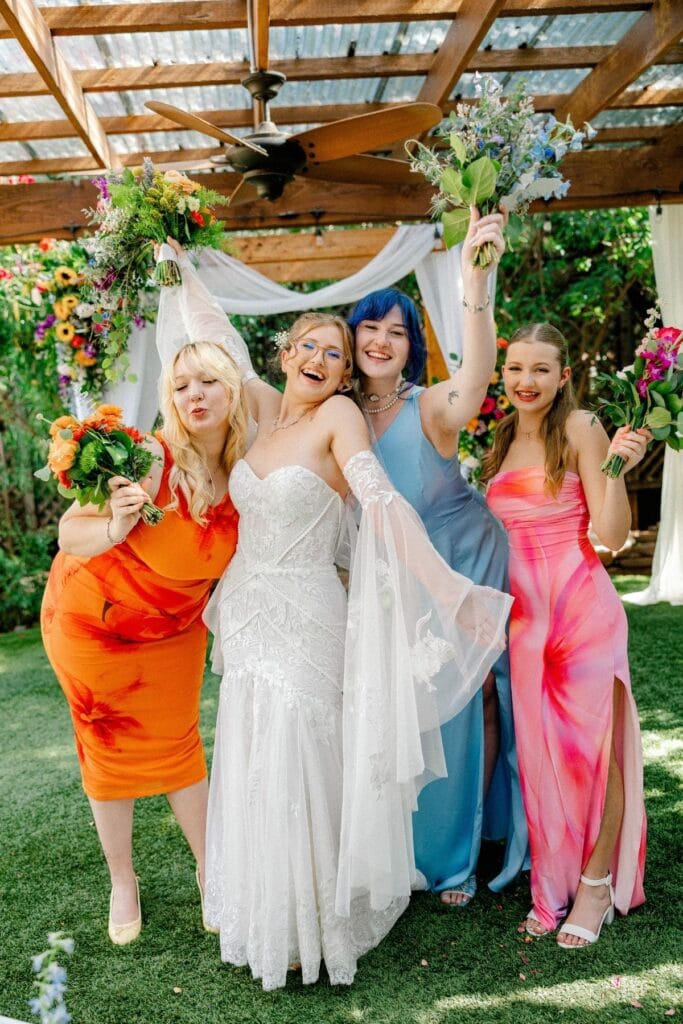
Today, dresses get a lot more latitude with bold options, different cuts, and personality-infused pictures. We loved the vibe of Kayla’s bridesmaids, and wedding photographer Thomas Shull captured the colors beautifully.
The White Wedding Dress
Plot twist: brides have not been wearing white since the dawn of matrimony. Before the 19th century, Western brides commonly wore all sorts of colors, often simply choosing a particularly nice dress they could wear again. Then Queen Victoria married Prince Albert in 1840 wearing white satin and Honiton lace. We’re not mad at a fashionable choice.
We’re just glad that this wedding trend from Sex & the City didn’t stick. Suffice it to say, so are the birds.
The Bridal Bouquet
Bridal bouquets were not always a lush armful of peonies arranged for Instagram. Earlier brides carried herbs, spices, garlic, dill, and other greenery thought to ward off bad spirits, encourage fertility, or mask less-than-fresh surroundings. Of course, another version says the herb-filled bunch helped fight off The Plague. Romance, but make it practical.
Over time, flowers took over—partly because they looked better in portraits and smelled considerably more pleasant than a clove-and-garlic situation. The bouquet toss later became a way to divert guests trying to rip the bride’s dress (see Garter Toss).
Father of the Bride Walking Her Down the Aisle
The sentimental aisle walk has a past that is more transactional than tender. In eras when marriage was an economic alliance between families, women had limited legal independence. A father “giving away” his daughter reflected the transfer of authority (and property/finances) to her husband.
A father’s escort can remain a cherished parent-child moment; others ask both parents to join them, walk alone, enter with their partner, or choose a different loved one. The point is no longer who is “entitled” to give the bride away—it is who, if anyone, the couple wants beside them.
Kissing the Bride
The wedding kiss may have evolved from the Christian “Kiss of Peace,” a ritual greeting meant to convey reconciliation and blessing—not romance. One popular, if hard-to-prove, story says a priest first gave the groom the Kiss of Peace, then had him pass it to his bride; some versions turn the whole congregation into a holy game of telephone.
However, what are the options? High-five? Say “The End”? Sing a song like in Napoleon Dynamite?
The Best Man
Today, the best man holds the rings, gives a toast, and hopefully prevents the groom from doing anything spectacularly stupid the night before the wedding. Some popular histories offer a much darker job description: helping a groom capture a bride or defending him against her angry family, with the “best” man supposedly being the best swordsman for the job. We’re having a hard time picturing Phil from The Hangover as a swordsman, tbh.
Toasting to the Couple
The first toast is tied to several traditions. Well, several sketch-at-best possibilities.
- One popular wedding-history story says the bride’s father took the first drink from a communal wine pitcher to prove it was not poisoned.
- The more reliable backstory is that Greeks and Romans raised wine in honor of gods and one another’s health.
- Later, English drinkers literally put toasted bread in wine to improve its flavor. So: blessings, booze, and possibly stale bread.
Want to ditch the toast and booze altogether? 6 percent of couples in Zola’s 2025 wedding-planning survey said they planned a completely alcohol-free celebration. That’s up from nearly 4 percent in 2023.
The Honeymoon History
The honeymoon was not originally a beach vacation with matching luggage and an aggressively filtered sunset. One common explanation links the word to the first month after marriage—one lunar cycle—when couples drank honey-based mead thought to bring sweetness, luck, and fertility. Other, far less charming origin stories connect wedding seclusion with marriage by abduction. It’s a useful reminder that not every “romantic” custom began romantically.
In Fact, Wedding Traditions Might Not Be As Old As You Think
For all the talk of centuries-old wedding customs, some things we now treat as practically mandatory are surprisingly modern. The wedding registry, for example, didn’t become a retail concept until Marshall Field’s introduced its bridal registry in 1924. The double-ring ceremony, where both spouses receive a wedding band, was still gaining popularity in the United States after World War II.
And that seemingly timeless rule that an engagement ring should have a diamond? Diamonds had been used in engagement rings for centuries, but they weren’t always the default. De Beers began marketing diamonds for engagements aggressively in the late 1930s, and copywriter Frances Gerety created “A Diamond Is Forever” in 1947.
Your Wedding, Your Way
Traditional, trendy, timeless, or something nobody in your family has seen before, your wedding should feel like you.
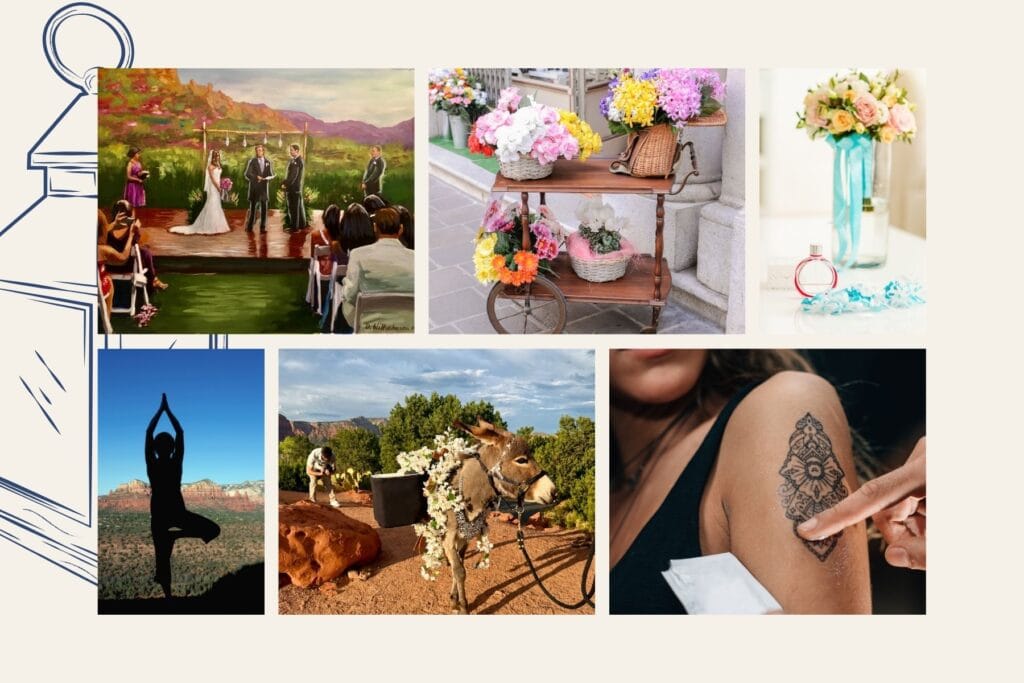
At Lantern Light Inn & the Wedding Gardens of Sedona, our intimate gardens and boutique inn give you the space and creative freedom to make that happen. Host 50 guests or fewer, choose the vendors who fit your vision (yes, even the beer burro), and turn a few scheduled hours into an extended experience. Trade the pressure of packing everything into a few hours for more time to settle in, stay awhile, and experience the day as it happens.
Our micro wedding investment options are designed with flexibility in mind, because the best wedding tradition might just be being fully present for your own.